“Visibility AI” in 2 Weeks — And Why Your Business Needs Its Own Version
Most local businesses live in a weird gap:
They’re great in person, and almost invisible online.
Relay, a local creator network that partners with dozens of independent businesses, kept running into the same problem:
Owners had no idea how visible they actually were across Google, Maps, AI assistants, social, and reviews.
And no one had time to figure it out.
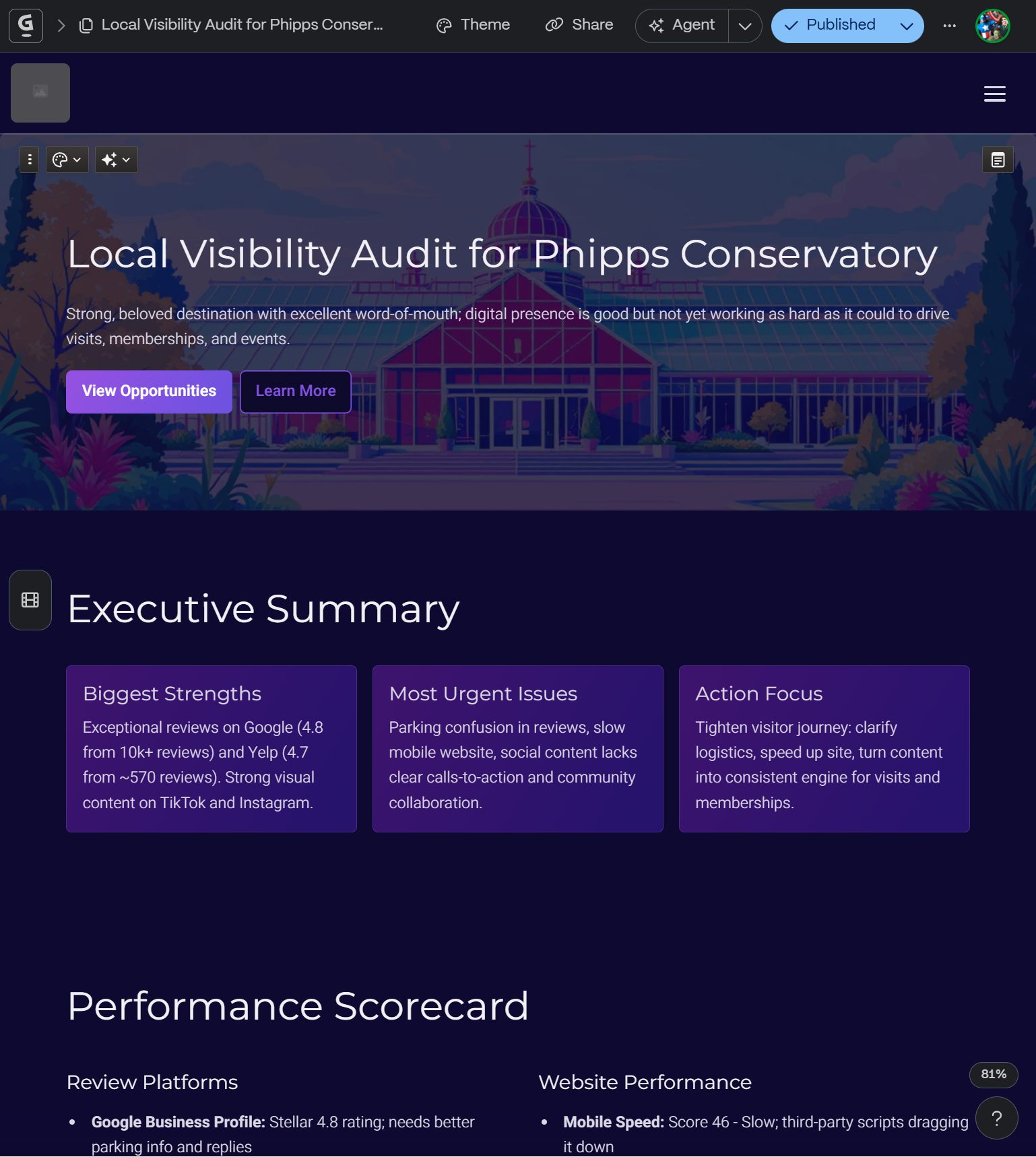
So Bait Shop built Visibility AI — a free, AI-powered audit that scans a business’s local footprint and sends back a simple scorecard and quick wins.
From first call to live tool: two weeks.
This is the story of how we did it, the stack we used, and what this approach could look like inside your organization.
The Brief: “We Need Proof, Not Vibes”
Relay came to us with a clear problem:
Their clients felt invisible or underperforming online
No standardized way to measure “local visibility”
No time for manual audits or one-off reports
They wanted a lead magnet that also delivered real value to operators
Success criteria looked like this:
Owner-friendly: Plain language, no SEO jargon, no 20-page PDF.
Fast: Form takes ~60 seconds, audit delivered in about an hour.
Deep enough to be useful:
Google + Maps presence
LLM / AI assistant visibility (what do tools like ChatGPT say about you?)
Social footprint
Reviews
Website basics and conversion leaks
Automated end-to-end: No analyst manually compiling anything.
In short: turn a messy, high-value question—
“Can people actually find us online?”
into a repeatable product that runs itself.
The Approach: Factory + Lab in One Build
Bait Shop runs everything through a Factory vs Lab lens.
Factory: Boring, essential automations that run every day without drama.
Lab: Experiments that feel new, test hypotheses, and can turn into new products.
Visibility AI needed to be both:
Factory: A reliable pipeline that pulls data, scores it, and sends reports without breaking.
Lab: A place to test different scoring models, channel weights, and recommendation styles.
We anchored the build around three non-negotiables:
Start from the output, not the stack.
We designed the final scorecard first:Local Visibility Score (0–100)
Channel-by-channel breakdown
“Fix these first” list (3–5 fast actions)
Optional deeper notes for power users
Minimize friction for the business owner.
The form asks for:Brand name
City
Website
Instagram (TikTok optional)
That’s it. The system hunts down the rest.
Treat the whole thing like a 2-week pilot, not a 6-month project.
We locked in:A tight 14-day timeline
A “good enough to ship” v1
Explicit room for iteration once real businesses started running through it
The Stack: Under the Hood of Visibility AI
Here’s what actually powers the tool.
1. Frontend & Delivery
Next.js – Single-page experience for the intake form and confirmation state
Cloudflare Workers – Fast, edge-deployed API layer to receive submissions and trigger workflows
Email delivery – Templated scorecard sent via transactional email (SendGrid / similar)
2. Orchestration
Zapier – The backbone workflow that:
Watches for new form submissions
Normalizes data (URLs, handles, city formatting)
Calls external APIs and internal scrapers
Aggregates results
Hands everything to the LLM for scoring & recommendations
Sends the final report back to the owner
Think of Zapier here as the Factory line — each step is a station: “pull Google data,” “pull reviews,” “check social,” “run analysis,” “send scorecard.”
3. Data + Scraping
Depending on the business, we pull from:
Google / Maps data (search + place details)
Review sites (review counts, recency, rating distribution)
Social profiles (basic presence, posting cadence, signals of activity)
Website (page structure, basic SEO & UX signals: hours, location clarity, calls-to-action, contact info)
For this we combine:
Native APIs where available
Scraping via headless browser / scraping services
A thin normalization layer so the LLM isn’t chewing raw soup
4. AI Layer
The AI does three jobs:
Summarization
“What does the internet think this business is?”
“What would a customer see in the first 2 minutes of searching?”
Scoring
Assigns a Local Visibility Score (0–100) based on a weighted model:
Presence: Do you exist on the major surfaces?
Completeness: Are profiles filled out, consistent, and accurate?
Social proof: Reviews, volume, recency, and spread.
Activity: Signs of life (recent posts, recent reviews).
The model is tweakable over time as we learn.
Prioritization
Produces 3–5 “Fix These First” actions
Each action is bite-sized, tactical, and written in plain language:
“Add your hours and address to your Instagram bio.”
“Ask 5 recent happy customers to leave a Google review this week.”
“Update your Google Business Profile with photos from the last 30 days.”
The key: no generic “improve SEO” fluff. Only moves an owner could literally hand to a manager or do themselves in 30–60 minutes.
The 2-Week Build: Start to Finish
Here’s how we got from idea to live tool in 14 days.
Days 1–2: Scope & Output
Worked with Relay to define:
Who is this for? (owner-operators, not marketing directors)
What do they get, exactly? (score + quick wins)
Where does this live in Relay’s funnel? (lead magnet → conversation starter)
Sketched the scorecard first: sections, visual hierarchy, tone.
Days 3–5: Data Pipeline & Skeleton
Built the Zapier backbone:
Trigger on form submit
Normalize input
Call stubbed functions for “get Google data,” “get reviews,” “get social,” etc.
Set up basic APIs / scrapers and stubs so we could test the plumbing end-to-end.
Days 6–8: Scoring Model & Copy
Designed the first version of the scoring logic:
Channel weights
Thresholds (what counts as “good,” “okay,” “weak”)
Prompt engineering for the LLM:
Consistent tone (direct, non-technical, actionable)
Clear structure for output JSON: score, channels, recommendations
Wrote the copy templates for the final email/report.
Days 9–11: Frontend & UX
Built the intake page in Next.js:
Minimal fields, clean layout, friction-free mobile experience
Clear expectations (“audit in ~1 hour,” “what we’ll send you”)
Wired it to Cloudflare Workers and Zapier.
Days 12–14: Edge Cases, Load, Launch
Ran a bunch of real-world tests:
Businesses with almost zero footprint
Overloaded footprints (lots of locations, tons of reviews)
Messy naming and conflicting data
Tuned:
Prompts for clarity and consistency
Timeouts and retries on scrapers / APIs
Email design for readability on phones
Soft launched with a small set of Relay partners, then opened publicly.
What the Owner Actually Experiences
From the business owner’s perspective, the experience is simple:
Click the link.
Spend ~60 seconds filling:
Business name
City
Website
Instagram
Keep doing their day.
A little later, an email lands with:
Local Visibility Score (0–100)
Quick scan of how they’re showing up across:
Google & Maps
AI assistants (LLMs)
Social
Reviews
Website
Top 3–5 “Fix These First” recommendations
No log-ins. No dashboards. No marketing lecture. Just: “Here’s where you stand. Here’s what to do first.”
Relay can then decide:
Which businesses might benefit from deeper support
Where creators can have the biggest impact
How to prioritize outreach based on who’s clearly under-visible but promising
Why This Matters Beyond Local Visibility
The point of Visibility AI isn’t just “a cool audit.”
It’s proof of a bigger idea Bait Shop lives on:
Most organizations have 1–3 critical, tedious workflows that should be products by now.
For Relay, that workflow was: “Help us quickly understand how visible a local business is, and what they should do about it.”
For your business, it might be:
Qualifying leads across 10 tools
Building weekly client reports
Scrubbing and enriching prospect lists
Onboarding new customers internally across 7 systems
Same pattern:
Define the outcome (e.g., a scorecard, a report, a prioritized list).
Design the output first.
Use automation and AI to do the ugly work between input and output.
Ship a v1 in weeks, not months.
That’s what we did with Visibility AI. And it’s repeatable.
If You Want Your Own “Visibility AI”
If you’re staring at a recurring internal headache and thinking:
“We do this 50 times a month by hand. Why isn’t this just a tool?”
That’s exactly the kind of problem we like.
Bait Shop works with teams to:
Identify those high-leverage workflows
Turn them into Factory-grade automations with Lab-grade experimentation built in
Deliver working tools in tight windows, like we did here in two weeks
If you want to explore what that looks like for your org, reach out and tell us:
“Here’s the tedious thing we keep doing that we wish was a product.”
We’ll take it from there.
